Workers in the construction industry use a variety of knives to perform tasks like scoring drywall, stripping electrical wire, and cutting through roofing materials. If you’re curious about what they stock in their toolbelts and how they use them, here’s a look at the knives that show up most on job sites.
Utility Knives
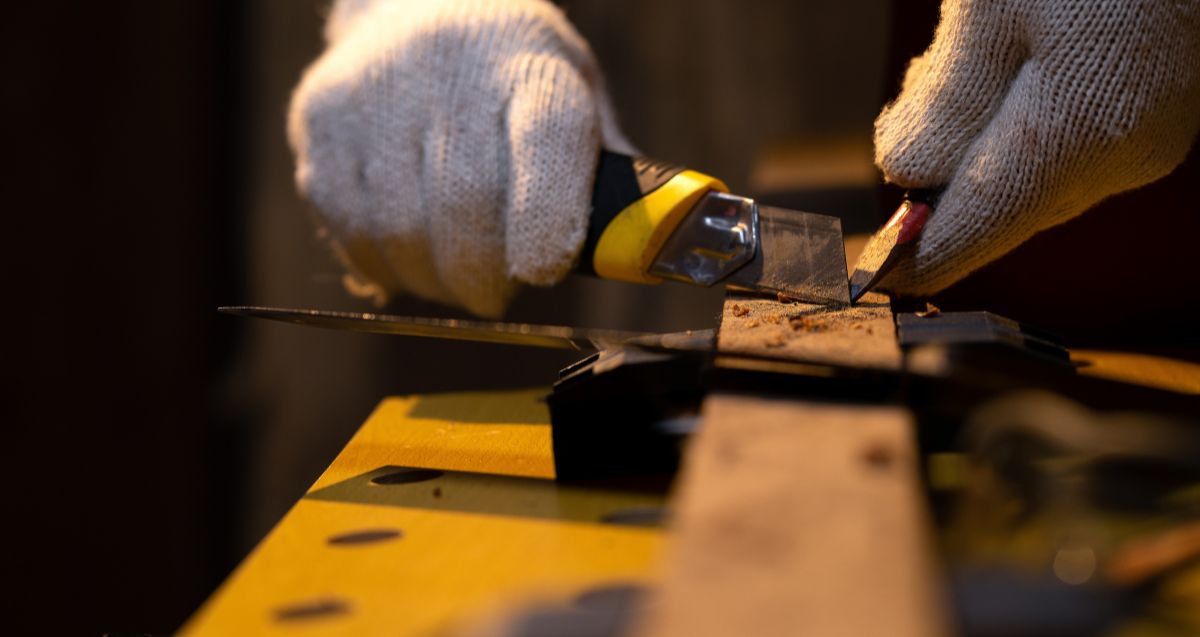
The utility knife runs on a retractable blade that slides out of a metal or heavy-duty plastic handle and locks at different depths depending on what’s being cut. Deeper extension works for thick insulation or vinyl flooring; a shallower setting gives more control on thinner materials. Blades are replaceable, which is the feature that makes this knife so universal across trades. When the edge dulls on rough material, a fresh blade goes in within seconds.
Box Cutters
Box cutters look similar to utility knives, but the blade is thinner and scored with breakaway segments. When the tip dulls, the front segment snaps off to expose a sharp edge underneath. On a busy job site, that’s a faster solution than stopping to replace a full blade. Box cutters are used for opening supply deliveries, cutting tape, and slicing through lightweight packaging materials rather than heavy construction substrates.
Roofing Knives
Roofing knives are built for asphalt shingles, and that specific purpose is visible in the design. The blade hooks at the tip so it can catch and drag through layered shingle material without requiring excessive downward force. Some versions include a notch in the blade for cutting around roofing nails. Working on a pitched surface with a standard blade is awkward and slow; the hooked design solves that problem directly.
Electrician’s Knives
Wire insulation doesn’t peel off on its own, and that’s where the electrician’s knife comes in. The blade is short with a slightly curved edge that strips insulation from electrical wire without nicking the conductor underneath. A damaged conductor creates a safety hazard, so the controlled cutting angle built into the blade design isn’t accidental.
Drywall Knives
Drywall knives aren’t knives in the traditional sense; they’re tools that are made with flexible blades for finishing work. The name comes from the blade shape itself, which resembles a knife edge. Professionals use these wide, flat blades to feather compound smoothly across drywall seams and achieve a surface that’s ready for paint. Blade width varies depending on the stage of finishing, with wider blades used for final coats.
The Right Knife for the Right Cut
Every knife on this list exists because a general blade doesn’t perform well in every situation. Roofing material resists a straight-edge cut. Wire insulation tears if the blade angle is off. Drywall finishing pulls unevenly without the right flex. Matching the knife to the task is what separates a clean result from a frustrating one, and that thinking carries through every trade on a construction site.
No products found.