Disclosure: This article may contain affiliate links. If you purchase through one of our links, KnifeBasics may earn a commission at no additional cost to you.
We regularly review and update this guide to ensure our recommendations and buying advice remain accurate, current, and helpful.
Quick Answer: Is 1.4116 Good Knife Steel?
Yes. 1.4116 is a good stainless steel for kitchen knives and other general-purpose cutlery.
Its biggest strengths are corrosion resistance, toughness, ease of sharpening, and reasonable edge retention. It is not a premium steel designed to provide maximum edge retention, but it offers a practical combination of performance and easy maintenance.
1.4116 is the EN material number for X50CrMoV15, a martensitic stainless steel commonly associated with German and European kitchen knives.
If you want a knife that is easy to maintain, resists corrosion, and can be quickly sharpened when it becomes dull, 1.4116 is a very practical choice.
Bottom line: 1.4116 is not an elite high-edge-retention steel, but it is a dependable, corrosion-resistant knife steel that works particularly well for kitchen cutlery.
What Is 1.4116 Steel?
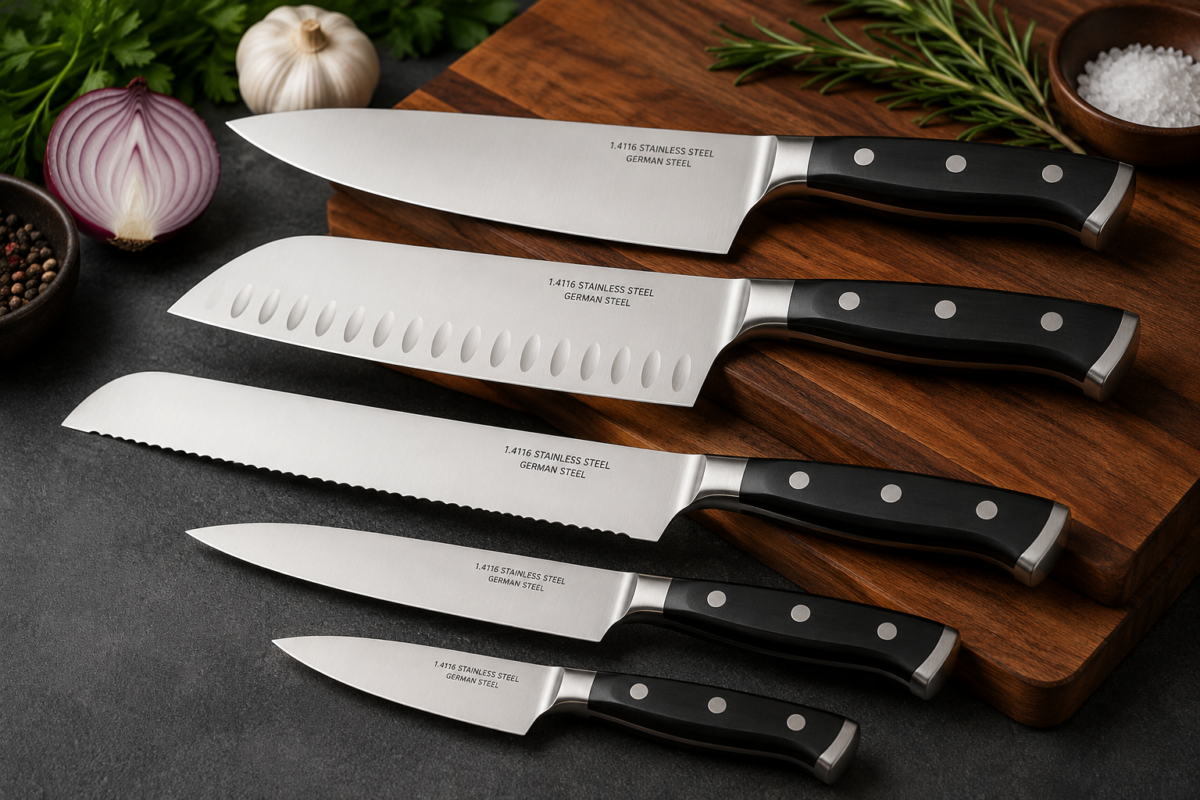
1.4116 is a martensitic stainless steel identified under the EN material-number system. Its corresponding short designation is X50CrMoV15.
The steel is widely used for cutlery and knives because it provides a useful combination of corrosion resistance, hardness, toughness, and wear resistance.
1.4116 is particularly associated with German-style kitchen knives. Its relatively moderate hardness also makes it easier to maintain than many harder, more wear-resistant knife steels.
The name can be confusing because you may see several designations used when researching the steel:
- 1.4116 — EN material number
- X50CrMoV15 — EN steel designation
- 4116 — commonly used commercial name
- German 1.4116 — common knife-industry description
- AISI 440A — often listed as a comparable or approximate equivalent
These designations should not automatically be treated as identical in every commercial form. Steel composition and heat treatment can vary between manufacturers.
1.4116 Steel Composition
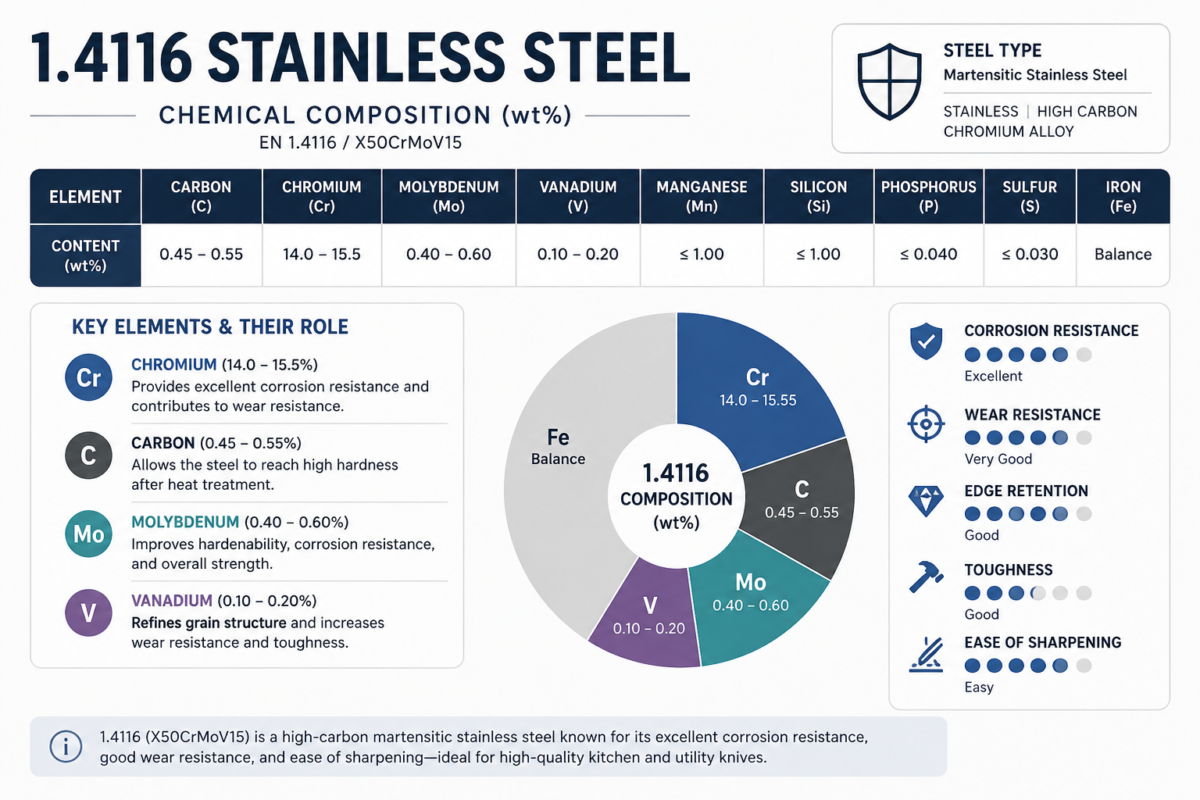
The standard composition of 1.4116/X50CrMoV15 includes approximately:
| Element | Typical Composition |
|---|---|
| Carbon (C) | 0.45–0.55% |
| Chromium (Cr) | 14.00–15.00% |
| Molybdenum (Mo) | 0.50–0.80% |
| Vanadium (V) | 0.10–0.20% |
| Manganese (Mn) | Up to 1.00% |
| Silicon (Si) | Up to 1.00% |
| Phosphorus (P) | Up to 0.040% |
| Sulfur (S) | Up to 0.030% |
The relatively high chromium content is primarily responsible for the steel’s strong corrosion resistance. Carbon contributes to hardness and edge performance, while molybdenum and vanadium contribute to hardenability, wear resistance, and the overall balance of properties.
1.4116 Steel Equivalent: What Is It?
The most important equivalent to know is X50CrMoV15.
1.4116 is the material number, while X50CrMoV15 is the corresponding steel designation. In practical knife discussions, these names are commonly used to describe the same standardized steel grade represented by the EN material number 1.4116.
You may also see AISI 440A listed as an equivalent or comparable steel. However, 440A should be treated as an approximate comparison rather than assuming that every 440A product has exactly the same chemistry or performance as 1.4116.
The important takeaway is:
1.4116 = X50CrMoV15 under the EN designation.
If a knife manufacturer lists X50CrMoV15, you are looking at the same standardized steel grade represented by material number 1.4116.
How Hard Is 1.4116 Steel?
1.4116 kitchen knives are commonly found in the mid-50s HRC, although the exact hardness depends on the manufacturer and heat-treatment process.
Some current 1.4116 kitchen knives are specified around 55–57 HRC, while other heat treatments can produce different results.
This relatively moderate hardness is part of the reason 1.4116 works so well for traditional kitchen knives. It provides enough hardness for useful edge retention while keeping the blade relatively easy to maintain.
Hardness alone, however, does not determine knife performance. Heat treatment, blade geometry, edge angle, and sharpening technique all have a major effect.
1.4116 Steel Properties
1.4116 Corrosion Resistance
Corrosion resistance is one of 1.4116’s strongest characteristics.
With approximately 14–15% chromium, 1.4116 is well suited to environments where a knife may regularly encounter water and food moisture.
This makes it particularly useful for kitchen knives, where corrosion resistance and easy maintenance are often more important than maximum edge retention.
Although 1.4116 is stainless steel, it is not completely immune to corrosion. Washing, drying, and storing the knife properly will help maintain the blade.
1.4116 Toughness
1.4116 offers good toughness for a stainless kitchen knife steel.
Its moderate hardness helps it resist the chipping that can occur more readily with some harder, more wear-resistant steels.
This is one reason 1.4116 works well for everyday kitchen knives. The steel is designed more around balanced performance and practical maintenance than extreme hardness.
1.4116 Edge Retention
1.4116 provides reasonable edge retention, but edge retention is not its greatest strength.
Harder and more wear-resistant steels can generally hold an edge longer.
The advantage of 1.4116 is that when the edge eventually becomes dull, the knife can be maintained relatively easily.
For a home cook who uses a knife regularly and is comfortable touching up the edge, this can be a very worthwhile tradeoff.
1.4116 Wear Resistance
1.4116 offers good wear resistance for a traditional stainless kitchen knife steel.
However, it should not be expected to match modern premium powder steels specifically designed for extreme wear resistance.
Its performance is better understood as a balance between corrosion resistance, toughness, edge retention, and ease of maintenance.
Is 1.4116 Easy to Sharpen?
Yes. One of 1.4116’s practical advantages is its relatively easy sharpening.
Because typical 1.4116 kitchen knives are not hardened to the extreme levels of some premium steels, they can generally be maintained with conventional sharpening equipment.
A quality whetstone or suitable sharpening system can restore the edge without requiring the specialized abrasives sometimes preferred for highly wear-resistant steels.
For users who would rather sharpen a knife occasionally than pay a premium for extreme edge retention, 1.4116 makes a lot of sense.
Is 1.4116 Good for Kitchen Knives?
Yes. 1.4116 is particularly well suited to kitchen knives.
Kitchen knives benefit from a combination of corrosion resistance, toughness, reasonable edge retention, and ease of sharpening.
1.4116 provides that balance.
It may not stay sharp as long as premium steels such as S30V or other highly wear-resistant alloys, but it is generally easier to maintain and provides excellent corrosion resistance for everyday kitchen use.
This is why 1.4116 and X50CrMoV15 are commonly found in German-style kitchen cutlery.
What Is 1.4116 Steel Used For?
1.4116 is widely used for:
- Kitchen knives
- Chef’s knives
- Santoku knives
- Utility knives
- Other cutlery
- Cutting tools
- Some surgical and industrial applications
Its corrosion resistance and balanced mechanical properties make it particularly useful where a durable stainless blade is required without the cost or sharpening demands associated with some premium steels.
1.4116 vs. 440C
440C generally provides better edge retention and wear resistance than 1.4116 when both are properly heat treated.
The higher carbon content of 440C allows it to reach greater hardness and develop more wear-resistant carbides.
1.4116 has the advantage of being easier to maintain and is commonly used in kitchen knives where corrosion resistance and ease of sharpening are important.
Choose 440C if: edge retention and wear resistance are higher priorities.
Choose 1.4116 if: corrosion resistance, easy sharpening, and practical kitchen performance matter more.
1.4116 vs. D2
D2 is a high-wear tool steel that generally offers better edge retention and wear resistance than 1.4116.
However, D2 is not considered a fully stainless steel in the same sense as 1.4116.
For a knife used around moisture, food, or humid conditions, 1.4116 has a clear corrosion-resistance advantage.
Choose D2 if: you prioritize wear resistance and edge retention.
Choose 1.4116 if: you want stronger corrosion resistance and easier maintenance.
1.4116 vs. AUS-8
1.4116 and AUS-8 are both practical stainless knife steels aimed at useful everyday performance rather than extreme edge retention.
AUS-8 can provide somewhat stronger edge retention depending on hardness and heat treatment, while 1.4116 has an excellent reputation for corrosion resistance and ease of maintenance.
The difference between the two may be relatively small in everyday kitchen use.
When choosing between knives made from these steels, blade geometry, heat treatment, construction, and overall knife quality can be more important than the steel designation alone.
1.4116 vs. 7Cr17MoV
7Cr17MoV is another stainless steel commonly found in value-oriented knives.
Both steels provide good corrosion resistance and practical everyday performance. The exact performance of 7Cr17MoV can vary considerably depending on the manufacturer and heat treatment.
For kitchen use, 1.4116 has a long history in German-style cutlery and remains a dependable choice when ease of maintenance is important.
1.4116 vs. S30V
S30V is a premium powder metallurgy stainless steel designed for high edge retention and wear resistance.
It generally holds an edge substantially longer than 1.4116, but it is also harder to sharpen.
1.4116 is the better choice when you want simple maintenance and strong corrosion resistance in a kitchen knife.
S30V makes more sense when maximum edge retention is a major priority, particularly for premium folding and EDC knives.
1.4116 Compared With Other Knife Steels
| Steel | Edge Retention | Toughness | Corrosion Resistance | Sharpening | Common Uses |
|---|---|---|---|---|---|
| 1.4116 | Good | Good | Excellent | Easy | Kitchen knives |
| 440C | Very Good | Good | Very Good | Moderate | EDC & general purpose |
| D2 | Excellent | Good | Moderate | Moderate | EDC & hard use |
| AUS-8 | Good | Good | Very Good | Easy | EDC & kitchen |
| S30V | Excellent | Good | Excellent | More difficult | Premium EDC |
These ratings are relative rather than laboratory measurements. Actual knife performance depends heavily on heat treatment, blade geometry, edge angle, and sharpening.
For a broader comparison of 1.4116 and other popular knife steels, see our Ultimate Knife Steel Comparison Chart.
Pros and Cons of 1.4116 Steel
Pros
- Excellent corrosion resistance
- Easy to sharpen
- Good toughness for everyday kitchen use
- Good balance of hardness and flexibility
- Widely used in kitchen cutlery
- Practical and relatively low-maintenance
- Good performance for the price
Cons
- Edge retention is only moderate compared with premium steels
- Not designed for extreme wear resistance
- Typically softer than many modern high-performance knife steels
- Not the best choice when maximum edge retention is the only priority
Who Should Buy a 1.4116 Knife?
1.4116 is a good choice for:
- Home cooks
- Professional kitchen users who value easy maintenance
- People who want a corrosion-resistant knife
- Users who prefer easy sharpening
- Buyers looking for dependable German-style kitchen cutlery
- Anyone who does not need extreme edge retention
👉 Browse today’s best-selling 1.4116 kitchen knives on Amazon →
You may want to consider a different steel if your primary goal is maximum edge retention or extreme wear resistance.
If you’re ready to compare actual knives, see our Top Selling Knives by Category guide for current recommendations.
Frequently Asked Questions
What is 1.4116 steel?
1.4116 is a martensitic stainless steel used extensively in cutlery and knives. Its corresponding EN designation is X50CrMoV15.
Is 1.4116 stainless steel?
Yes. 1.4116 is a stainless steel with approximately 14–15% chromium, giving it strong corrosion resistance.
What is 1.4116 steel equivalent to?
The most important equivalent designation is X50CrMoV15. AISI 440A is often listed as a comparable or approximate equivalent, but it should not be assumed that every 440A product has identical chemistry or performance.
Is 1.4116 good knife steel?
Yes. 1.4116 is a good knife steel, particularly for kitchen knives. It offers excellent corrosion resistance, good toughness, reasonable edge retention, and easy sharpening.
Is 1.4116 German steel?
1.4116 is commonly associated with German knife manufacturing and German-style kitchen cutlery. However, the standardized steel grade can be produced by different manufacturers and in different countries.
What is the composition of 1.4116 steel?
1.4116 contains approximately 0.45–0.55% carbon, 14–15% chromium, 0.50–0.80% molybdenum, and 0.10–0.20% vanadium, with manganese and silicon generally limited to about 1%.
How hard is 1.4116 steel?
Knife blades made from 1.4116 are commonly found in the mid-50s HRC, although the exact hardness depends on the manufacturer and heat treatment.
Does 1.4116 steel rust?
1.4116 has strong corrosion resistance and is much less prone to rust than many non-stainless steels. However, stainless steel is not completely rustproof, so proper cleaning and drying are still recommended.
Is 1.4116 better than 440C?
Not universally. 440C generally offers better edge retention and wear resistance, while 1.4116 is easier to sharpen and is well suited to corrosion-resistant kitchen cutlery.
Is 1.4116 better than D2?
It depends on your priorities. D2 generally provides better edge retention and wear resistance, while 1.4116 provides much stronger corrosion resistance and easier maintenance.
Is 1.4116 easy to sharpen?
Yes. 1.4116 is generally easier to sharpen than many harder, more wear-resistant premium knife steels.
Final Verdict: Is 1.4116 Good Knife Steel?
1.4116 is a dependable stainless steel that remains an excellent choice for kitchen knives and everyday cutlery.
Its greatest strengths are corrosion resistance, toughness, ease of sharpening, and balanced everyday performance.
It does not offer the extreme edge retention of premium powder steels, but that is not necessarily a disadvantage for the average home cook. A knife that is easy to sharpen and resistant to corrosion can be more practical than one that holds an edge longer but requires more specialized maintenance.
If you want a reliable, low-maintenance kitchen knife with good corrosion resistance and straightforward sharpening, 1.4116 is a very good choice.
To compare 1.4116 with dozens of other popular knife steels, visit our Ultimate Knife Steel Comparison Chart.
No products found.