Reviewed by: KnifeBasics Editorial Team
Originally Published: July 19, 2025
Last Updated: August 12, 2026
Reading Time: 8 minutes
Disclosure: This article may contain affiliate links. If you purchase through one of our links, KnifeBasics may earn a commission at no additional cost to you.
We regularly review and update this guide to ensure our recommendations and buying advice remain accurate, current, and helpful.
What Is FC61 Steel?
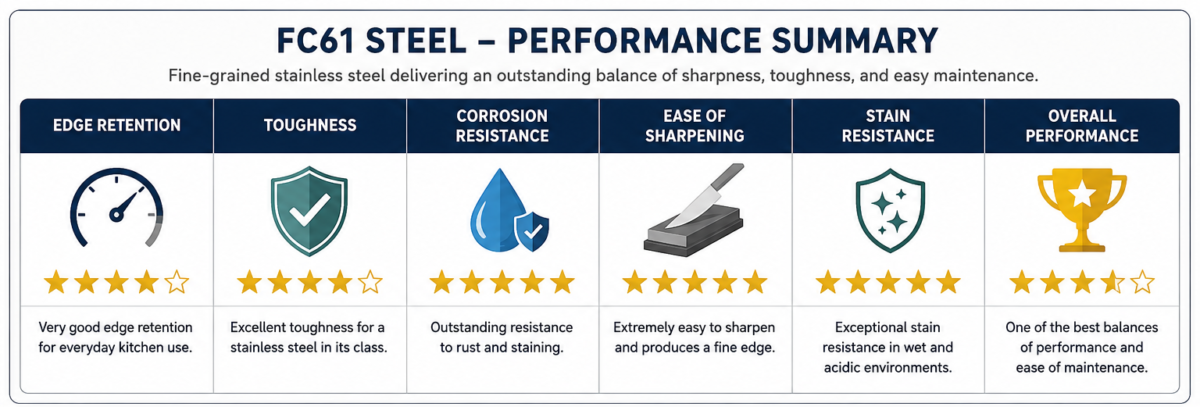
FC61 is a fine-grained stainless steel used in premium kitchen knives, particularly Japanese-style cutlery. FC61 is associated with Sandvik 13C26 and is very closely related to AEB-L. Its relatively simple alloy composition produces a fine microstructure that is well suited to producing a keen, refined cutting edge.
FC61 is especially popular in Miyabi and other Japanese kitchen knives. Current Miyabi products using FC61 are hardened to approximately 61 HRC and are marketed for sharpness, edge retention, and corrosion resistance.
The biggest appeal of FC61 is its balance. It does not compete with the most wear-resistant premium steels for maximum edge retention, but it offers excellent cutting performance, good toughness, stainless corrosion resistance, and the ability to take a very fine edge.
Quick answer: Yes, FC61 is a very good knife steel, particularly for kitchen knives where a fine edge, corrosion resistance, and cutting performance are important.
Tip: If you’re comparing FC61 with other knife steels, see our Ultimate Knife Steel Comparison Chart for a side-by-side look at edge retention, toughness, corrosion resistance, and sharpening characteristics.
FC61 Steel Composition
FC61 is associated with the composition of Sandvik 13C26. A typical 13C26 composition is approximately:
- Carbon: 0.68%
- Chromium: 13.00%
- Manganese: 0.70%
- Silicon: 0.40%
- Sulfur: 0.01%
- Phosphorus: 0.025%
The alloy is relatively simple compared with many modern powder metallurgy steels. It contains no significant additions of vanadium, molybdenum, or tungsten.
This clean composition contributes to the fine microstructure for which the 13C26/AEB-L family is known.
Properties of FC61 steel
FC61 Steel Hardness
FC61 knives are commonly hardened to approximately 61 HRC, although the actual hardness depends on the manufacturer and heat-treatment process.
For example, current Miyabi FC61 knives list a blade hardness of 61 HRC.
A hardness around 61 HRC provides a good foundation for edge stability and wear resistance while still allowing the fine-grained steel to deliver excellent cutting performance.
FC61 Steel Edge Retention
FC61 provides good edge retention, but edge retention is not its greatest strength.
More wear-resistant steels containing larger amounts of carbide-forming elements can generally hold an edge longer. FC61 instead emphasizes a combination of fine edge performance, toughness, corrosion resistance, and manageable maintenance.
For kitchen knives, this can be a very desirable tradeoff. A knife does not necessarily need the highest possible edge retention if it can be sharpened effectively and produces an excellent cutting edge.
FC61 Steel Wear Resistance
FC61 offers good wear resistance for its alloy composition and typical hardness.
However, it should not be confused with highly wear-resistant powder steels such as S90V or Maxamet. Those steels are specifically designed to maximize resistance to abrasive wear and can maintain an edge substantially longer under appropriate conditions.
FC61 takes a different approach: it combines respectable wear resistance with a very fine microstructure and good toughness.
FC61 Steel Toughness
Toughness is one of FC61’s major advantages.
The fine microstructure associated with the 13C26/AEB-L family helps produce a steel that can support thin, fine edges without relying on large, brittle carbide structures.
This makes FC61 particularly well suited to kitchen knives, where thin geometry and a refined cutting edge are highly desirable.
FC61 Steel Corrosion Resistance
FC61 has good corrosion resistance because it contains approximately 13% chromium.
It is well suited to kitchen environments, where knives are regularly exposed to water, food acids, and other sources of corrosion.
However, stainless does not mean rustproof. The knife should still be washed, dried, and stored properly. Avoid leaving it submerged in water or wet for extended periods.
Is FC61 Easy to Sharpen?
FC61 can produce an excellent edge, but a knife hardened to approximately 61 HRC should be sharpened with appropriate equipment and technique.
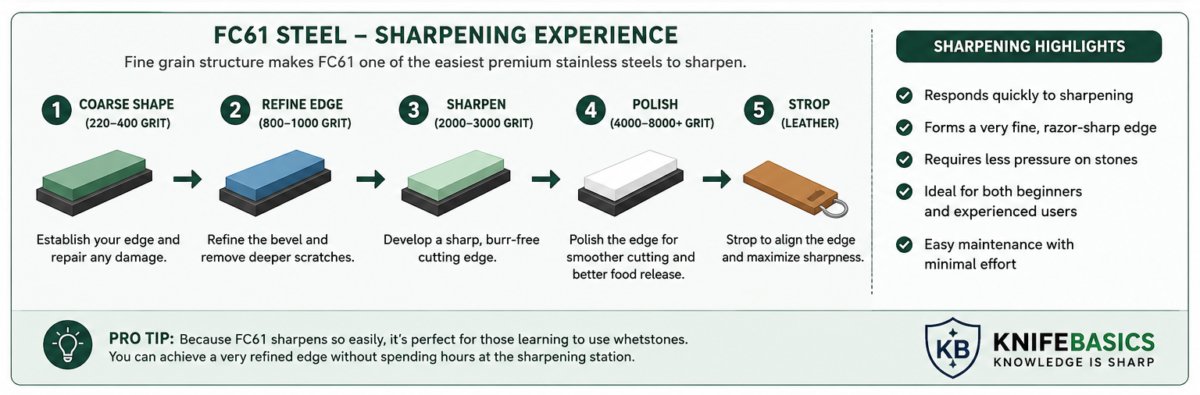
A quality whetstone is an excellent choice for maintaining an FC61 kitchen knife. Because FC61 is a fine-grained steel, it can take a very refined edge when properly sharpened.
For routine maintenance, avoid aggressive automatic sharpeners that remove unnecessary amounts of steel or use uncontrolled angles.
FC61 Sharpening
A whetstone is one of the best ways to maintain an FC61 kitchen knife.
A medium-grit stone around 800–1,200 grit is appropriate for routine sharpening, while a finer stone can be used when a more refined edge is desired.
The exact sharpening progression depends on how dull the knife has become. There is no need to use multiple extremely fine stones simply because the steel is capable of taking a fine edge.
The most important factors are maintaining a consistent angle, using appropriate pressure, and removing only the amount of steel necessary to restore the edge.
FC61 Steel Comparison
FC61 vs. VG-10
FC61 and VG-10 are both popular stainless steels used in Japanese kitchen knives.
VG-10 generally offers stronger edge retention, while FC61 is particularly attractive for its fine-grained structure and toughness.
VG-10 contains vanadium and other alloying elements that contribute to carbide formation and wear resistance. FC61 has a much simpler composition.
Choose FC61 if you value:
- A fine, refined edge
- Good toughness
- Excellent kitchen performance
- Stainless corrosion resistance
- Japanese-style kitchen knives
Choose VG-10 if longer edge retention and broader availability are higher priorities.
FC61 vs. SG2
SG2 is a powder metallurgy stainless steel that generally offers greater wear resistance and edge retention than FC61.
FC61’s advantage is its simpler composition and fine-grained structure, which make it particularly well suited to thin kitchen knife edges.
If maximum edge retention is your primary concern, SG2 is likely the better choice. If you prefer a balanced kitchen steel with excellent cutting performance and good toughness, FC61 is very attractive.
FC61 vs. 14C28N
FC61 and 14C28N are both fine-grained stainless steels from the Sandvik family, but they are optimized somewhat differently
14C28N is widely used in folding and general-purpose knives, while FC61 has become particularly associated with Japanese kitchen knives.
Both can offer excellent toughness and corrosion resistance. FC61’s approximately 61 HRC kitchen-knife applications and fine edge make it especially interesting for culinary use.
FC61 Compared to Similar Knife Steels
| Steel | Edge Retention | Toughness | Corrosion Resistance | Ease of Sharpening | Common Uses |
|---|---|---|---|---|---|
| FC61 | Good | Excellent | Excellent | Good | Kitchen knives |
| VG-10 | Very Good | Good | Excellent | Good | Kitchen & EDC |
| 14C28N | Good | Excellent | Excellent | Excellent | EDC & general purpose |
| SG2 | Excellent | Good | Excellent | Moderate | Premium kitchen knives |
| AEB-L | Good | Excellent | Excellent | Good | Kitchen, EDC & custom knives |
These ratings are relative rather than laboratory measurements. Actual knife performance depends heavily on heat treatment, blade geometry, edge angle, and sharpening.
Key Takeaway: FC61 stands out because it combines a very fine grain structure with excellent corrosion resistance and extremely easy sharpening. While some steels offer slightly longer edge retention, few provide the same balance of cutting performance and low maintenance.
Popular Knives Made With FC61 Steel
Although FC61 isn’t as widely used as VG-10 or AUS-10, several respected knife manufacturers use it because of its fine grain structure, excellent corrosion resistance, and ability to take an extremely sharp edge.
| Knife | Blade Type | Why It Uses FC61 |
|---|---|---|
| Zwilling Pro Le Blanc Chef’s Knife | Chef’s Knife | Excellent balance of sharpness, toughness, and stain resistance. |
| Zwilling Pro Le Blanc Santoku | Santoku | Fine edge for precise vegetable and meat slicing. |
| Zwilling Diplôme Chef’s Knife | Chef’s Knife | Designed for professional culinary training and everyday commercial kitchen use. |
| Miyabi Koh Series (selected models) | Utility & Chef’s Knives | Offers a refined cutting edge with straightforward maintenance. |
Note: Knife manufacturers occasionally change blade steels during production runs. Always verify the steel listed for the specific model before purchasing.
What Is FC61 Steel Used For?
FC61 is especially associated with premium kitchen knives.
If you’re ready to compare actual knives, see our Top Selling Knives by Category guide for current recommendations across kitchen, pocket, hunting, and fixed-blade knives.
Current Miyabi products use FC61 in chef’s knives, santoku knives, paring knives, and other kitchen cutlery. ZWILLING’s current product specifications list FC61 as the blade material and approximately 61 HRC hardness on several Miyabi lines.
FC61 is a particularly good fit for kitchen knives because cooks often benefit more from a thin, sharp, corrosion-resistant blade with good toughness than from extreme edge retention alone.
Looking for an FC61 kitchen knife? Browse current FC61 kitchen knives on Amazon →
Is FC61 Good Knife Steel?
Yes. FC61 is an excellent knife steel, especially for kitchen knives.
Its greatest strengths are its fine-grained structure, good toughness, corrosion resistance, and ability to take a very sharp edge.
Its main limitation is edge retention. If you want a steel that stays sharp for the longest possible time, there are better choices. But if you want a well-balanced kitchen knife that delivers excellent cutting performance and can be maintained with conventional sharpening equipment, FC61 is an excellent option.
Looking for an FC61 kitchen knife? Browse current FC61 kitchen knives on Amazon →
Choose FC61 if you:
- Want a premium Japanese-style kitchen knife
- Prefer a very fine cutting edge
- Value toughness and thin blade geometry
- Want good corrosion resistance
- Don’t mind occasional sharpening
- Prefer balanced performance over maximum edge retention
Consider another steel if you:
- Want the longest possible edge retention
- Prefer highly wear-resistant powder steels
- Frequently cut abrasive materials
- Want to minimize sharpening as much as possible
Frequently Asked Questions
Is FC61 steel the same as 13C26?
FC61 is associated with Sandvik 13C26 and is listed as an equivalent/proprietary name in several knife-steel references. FC61 and 13C26 have essentially the same published composition, although the final performance of a knife depends on heat treatment and manufacturing.
Is FC61 the same as AEB-L?
FC61/13C26 and AEB-L are extremely closely related steels with very similar compositions and fine microstructures. They are commonly treated as equivalent or near-equivalent steels in knife-steel references, although the steelmaker and specific heat treatment can differ.
How hard is FC61 steel?
FC61 kitchen knives are commonly hardened to approximately 61 HRC. Current Miyabi FC61 products list 61 HRC blade hardness.
Does FC61 steel rust?
FC61 has good corrosion resistance because of its approximately 13% chromium content, but it is not rustproof. Proper cleaning and drying are still important.
Does FC61 hold an edge well?
Yes. FC61 provides good edge retention, but it does not compete with the most wear-resistant premium steels. Its strength is the overall balance between edge performance, toughness, corrosion resistance, and maintenance.
Is FC61 hard to sharpen?
FC61 can take an excellent edge, but at approximately 61 HRC it benefits from proper sharpening technique. A quality whetstone is an excellent option for maintaining an FC61 kitchen knife.
What knives use FC61 steel?
FC61 is used in a number of Miyabi and other premium Japanese-style kitchen knives. Current Miyabi product pages list FC61 as the blade material in several chef’s, santoku, paring, and other kitchen knives.
Is FC61 better than VG-10?
Not necessarily. VG-10 generally offers stronger edge retention, while FC61 is attractive for its fine-grained structure, toughness, and excellent cutting performance. The better choice depends on what you value most in a kitchen knife.
FC61 Steel: Final Verdict
FC61 is an excellent all-around steel for premium kitchen knives.
It isn’t the steel to choose if your only goal is maximum edge retention. Instead, FC61 offers an appealing combination of fine edge performance, toughness, corrosion resistance, and good maintenance characteristics.
Its approximately 61 HRC hardness allows FC61 kitchen knives to maintain a stable, sharp edge, while its fine-grained structure makes it particularly well suited to thin Japanese-style blades.
For cooks who appreciate a very sharp knife and don’t mind maintaining the edge periodically, FC61 is a steel worth considering.
To see how FC61 compares with dozens of other popular knife steels, visit our Ultimate Knife Steel Comparison Chart.